Monday, April 23, 2012

Spain.

Architecture.

1. The first thing you see when you go to Madrid, Spain or elsewhere in the world is the airport. Most airports look the same, so flying into the Madrid-Barajas Airport was something nice and different. It had a colorful wood ceiling sustained by pillars in form of a "Y". Besides the colorful part of it which was nice because it wasn't you're plain airport, the ceiling had texture. It was in the form of many waves.


2. Cathedral in Toledo, Spain. It was one of the most interesting buildings I've seen. It had enumorous amount of carved out sculptures on the walls of the building. It had arched ceilings and stain glass windows. It held paintings made by El Greco, famous artist. It's amazing that this gothic structure was built from 1226 to 1493.


3. Palacio real de Madrid. The King's Palace. It was one of the nicest things to see. It was like the white house of Spain. Located next to the Cathedral of Madrid. It has a barroc style and was built from 1738 to 1892.


Infrastructure.


1. Plugs. Plugs were majorly different. I was very happy to know that I could borrow some converters to be able to plug my stuff into the outlets.

2. Street names. So there are no signs in the corners of an intersection that saw what street you are on. Nor are there signs that hang from street llights to tell you where you are. So, where are the street names? They are located on the walls of buildings.


3. Baday Toilet (Bidet). When you first see one of these it's kind of odd. You always hear about them but you never actually see them, until you go to Europe. I guess it is sanitary to use one of these so it's also odd that they wouuldnt be used in the USA.

Thursday, March 1, 2012

3.1.2 Basic Flowcharting Ppt


1. Flowcharting is similar to using a map to plan a route for a trip because one starts at one place and follows the lines to get to another.

2. My average day


*orange = possible question

Wednesday, February 29, 2012

Money Ball Movie

1) What was the “Moneyball”approach that Billy Beane and Peter Brandt applied to the Oakland Athletics 2002 season? Was it an “art” or a “science”? What single statistic did they boil their value consideration down to? (In class research/discussion)
Billy Beane and Peter Brandt decided to use factual data and statistics to get the best players and win the season. It was a science. The used the single statistic of "who gets most on base" to narrow it down to the best players.

2) What is the equation used to calculate OBP? (In class research/discussion)
OBP = (Hits + Walks + Hit by Pitch) / (At Bats + Walks + Hit by Pitch + Sacrifice Flies).

3) What is design? (In class research/discussion)

A plan produced to show the look and function or workings of a building, garment, or other object before it is built or made.


4) Describe 3 situations where movie characters (intentionally or not) applied a step from the PLTW 12 Step Design Process. Explain both the (a) situation as well as (b) how the step is relevant:
1 -He had a vision or a plan.

2 - He designed a team based on his statistics.

3 - He fired people who didn't work well and hired new ones to fit the missing job. He reiterterate the process of building a proper team.


5) What is “Leadership”? List the three aspects of leadership that we come up with in class. (In class research/discussion)

1 -Direction
2 -Alinement
3 -Committment


6) Describe 3 circumstances from the story where a character exercised effective leadership:
1 - Billy Beane had a vision.

2 - Billy Beane committed to his choices regardless of risk factor.

3 -He resolved problems.


7) According to the movie, what was the A’s record at the start of their winning streak? _76__ : __51_
8) What does this ratio simplify to (roughly)? _1.5__ : 1

9) How long was the A’s record setting winning streak? _20__ games won.

10) Given the A’s win/loss ratio at the start of the streak (listed two questions above), what are the odds of winning 20 games in a row? Run the numbers. (In class research/discussion)
76/(76+51) = .59     .59^20 = .0000261       .00261%

11) Based on your calculation, do you think the A’s got lucky or was there something to the Moneyball approach?
I think there was both luck and math approached to win. They had their calculations so it was obviously possible to have 20 straight wins but you never know how a player will play on a specific day.

12) Did Billy Beane strictly apply the “science” of Moneyball to his management approach? Was there an “art” to his efforts as well? Describe a circumstance where he broke from the Moneyball approach to make a positive change for the team.
There was an art to his efforts because he didn't strictly stick to the moneyball approach but do to his experience he realized his odds would raise if he gave emotional support to the team which would boost their confidence. He also fired Giambi (?) because he had poor moral.


Bonus Question (look into this if you’ve finished ahead of the class):
Money Ball was originally a book. What author wrote the book? What other books has this author written? Is there a theme to his writing?
Michael Lewis was the author. He also wrote Panic: The Story of Modern Financial Insanity, The Blind Side: Evolution of a Game , etc. His book have a common them of involving economics in any real life situation.

It's "Oscar Season", will Moneyball win the Oscar for any of the categories it's up for?
It had many nominations but it didn't win any of them.

Wednesday, February 22, 2012

3.1.5 Variable Functions


Q1: 5 seconds

Q2: you can change +1 to -1 or +(-1)

Q3: the number of times a manufactured item has been made (stock/inventory

3.1.4 Branch Functions


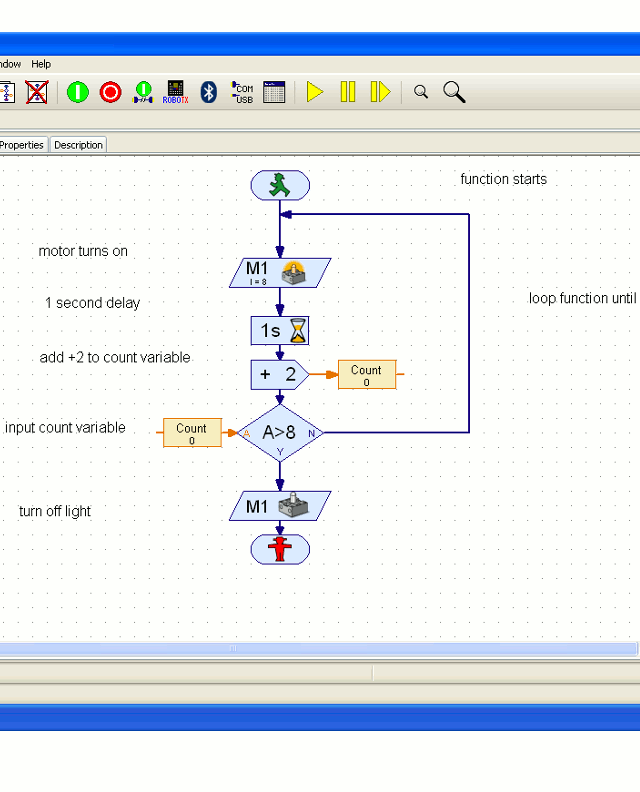
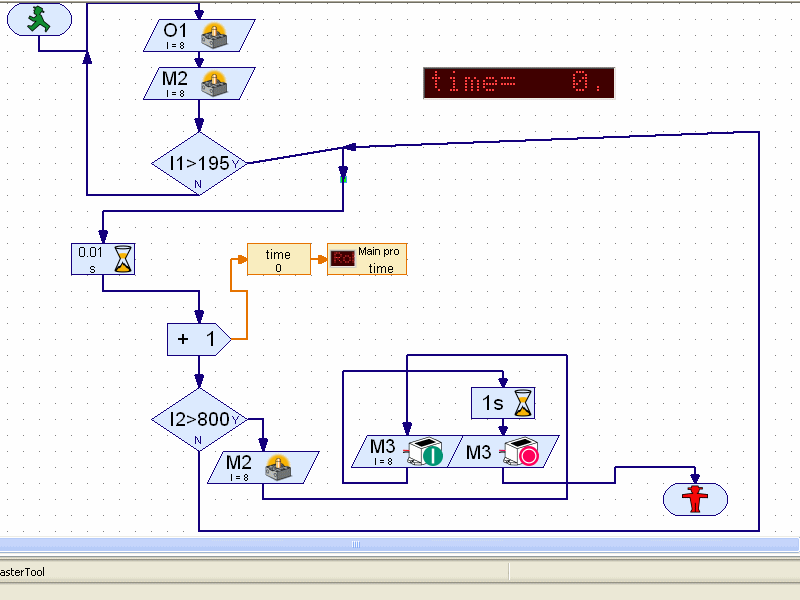
Project 3.1.7 Machine Control Design

Team Members: Isabel, Daniel, Carley

Problem 1: Start / Finish Line (Hardware Level 1 | Software Level 4)
The Olympic committee would like your team to invent a control system for use with track and field running events. They want this device to automatically record the time and beep when the first runner crosses the start / finish line.
[INSERT IMAGE OF TWO POTENTIAL PHYSICAL SKETCHES]
[INSERT IMAGE OF FINAL PHYSICAL SKETCH]

  Program Sketch
 Final Program


CONCLUSION QUESTIONS

1. What was the most difficult part of the problem?

The most difficult part of the problem was wiring the switches to coincide perfectly and properly with the program already set in place - the mix up and the innumerable pieces of wire were really hard to operate around as well, and figuring out and keeping track of the inputs and outputs made things even more difficult.

2. List and describe two features that were not part of the design problem that could be added to improve your design.

Better sensors would have been nice - perhaps color sensors pre-programmed to sense the colors of the contestants in the Olympics to differentiate and provide proper statistics for the record. When we went to record the time on the program, it would have also been more convenient to have it continue going, but stop as each person crossed the line. However, given the time limit, such a feat could not be achieved.

Friday, January 6, 2012

The Smartest Machine on Earth

What is "machine learning"?
Learning from examples.

How did the IBM team employ that concept in the development of Watson's AI? What advantage did that provide over previous attempts at "intelligence"?
By having the machine learn from examples it can create patterns that will help it figure out things out for themselvs. This facilitates the IBM teams job because somethings are to difficult to explain like "what is the letter A" it's easier to show it many examples of a letter "a".

I've often mentioned the term "Empirical Scepticism". What does that mean? How does that relate to the concept of Machine Learning? How does this relate to your life?
Empirical Scepticism is questioning beliefs on the basis of scientific understanding. You learn off of trial and error and it seems that machine learning is learning from examples and everytime watson has a mistake he corrects it and tests it.

Wednesday, January 4, 2012

Ground Zero

Happy New Year!

Ground Zero:

What different "trades" (types of construction work) are featured in this video? Name at least three.
Steal work, glass work, bronze memorial plate work.

What aspect of the project is most interesting to you? Why is that?
The aspect that was most interesting to me was how they had to have all the materials tested to make sure that it could support the building. For example, testing creating the cement and testing it on site, and making the glass and testing it.

Thursday, November 3, 2011

Happy Halloween!


I tried my best to use the inventor program, though everytime I tried to do something it seemed something else would go wrong. I even tried adding color but when I saved it, the color didn't save or something happened.

Wednesday, November 2, 2011

The Deep Dive

1. “From the buildings in which we live and work, to the cars we drive, or the knives and forks with which we eat, everything we use was designed to create some sort of marriage between ______form___________ and ______function___________.”


2. The folks at IDEO state that they are not experts in any given area. But, they do claim to be experts on the _Process of Design______, which they apply to the innovation of consumer products.


3. After the team of designers is brought together, told the problem, and informed they have five days to “pull it off,” what phase of the design process do they immediately engage in?

They first listed all the issues and safety hazards and then got out to observe shoppers.

4. Give two examples of what the team members did during this phase.
a. Went to the supermarket to see the product in use

b. took pictures to later analyse what was going on


5. List five rules-of-thumb that IDEO employees follow when they share ideas during the brainstorming phase:

a. One conversation at a time.
b. Stay focused on topic.
c. Encourage wild ideas.

d. Differ Judgement

e. Build on the ideas of others.

6. Why should wild (and sometimes crazy) ideas be entertained during the brainstorming phase?
Because others can than build of those ideas.


7. After the brainstorming phase was over, the team narrowed down the hundreds of ideas by ___Voting____ for those ideas that were not only “cool” but also _____Build-able____ in a short period of time. What phase of the design process is this called?

Enlightened trial and error

8. IDEO believes that the ideas and efforts of a ____Team____ will always be more successful than the planning of a lone genius.


9. Once the ideas were narrowed down and divided into categories, the group was split into four smaller teams. What phase(s) of the design process was each of these groups responsible for?

1. Shopping
2. Safety
3. Check out
4. Finding what you're looking for.

10. The leaders at IDEO believe that _____Crazy_____ behavior and a ____Playful____ environment are two important reasons why their employees are able to think quickly and creatively to produce innovative results.


11. Sometimes, people come up with great solutions that work by trying their ideas first, and asking for _____Forgiveness_____ later.


12. Design is often a process of going too far and having to take a few steps back. What phase of the design process would the critique of the four mock-ups come under?

Iterative Design

13. Upon critique of the four teams’ models, it was obvious that none of the teams had developed an optimum solution. However, the people at IDEO believe that it is important to ___Fail___ often in order to ____Succeed___ sooner.


14. What percentage of the entire week’s time did it take to fabricate the final prototype?

I'm not totally clear on the percent but they did spend the whole last night building it.

15. Instead of showering his design team with a tremendous amount of praise, what did the boss require his employees to do with their new design?

Test it out and outside people's opinions.

16. Of all the things that we are surrounded by every day, what has not been placed through the design process?

Nature.


Conclusion

1. What did you find to be the most impressive part of the team’s effort?

 I think was most impressive was the perseverance the team had to accomplish the task. They didn't give up.

2. What advantages are there to having a design team with members that have non-engineering backgrounds?

It gives room to more wild ideas that they can build off of when designing new things.

3. There was a point in the process where a self-appointed group of adults stepped up, stopped the ideas, and redirected the group to break up into teams. Why was this done?

The breaking up into groups was necessary because it helped redirect the group and have a better focus on different aspects of building the car, or else that phase of the design process could have gone on forever.


4. At the end of the video, Dave Kelly states, “Look around. The only things that are not designed are the things we find in nature.” Can you think of anything that would contradict this statement?

Parks and gardens would be a contradiction because landscape architects design an area by using plants, etc to make an area look more appealing.

Thursday, October 27, 2011

Energy Resources


1. The thing that surprised me the most was the fact that energy is conserved. It can neither be created or destroy and only a percent of the energy created is actually useful to us.

2. One thing that surprised me was that natural gas accounts for 1/5 of energy production in the word. It also is 90% efficient meaning that only 10% would be considered waste, but it counts for 60% of pollution.

3. Describe and defend what you believe to be the best energy source(s) to be investing in.
I definitly believe we should be investing our time and money into using all the inexahaustable energy sources espicially solar beacuse solar panels can easily be placed on top of houses and building so everyone would be producing their own energy and there are very low bad consecuences to using this type of energy source. It won't have effects on the enviroment like those of using nuclear energy or coal powered energy.

Friday, October 21, 2011

Cardboard Canoe

13 ACHIEVEMENTS (Potentially 14 or 15)

Tape Selection
  • 2'' by 60 yds =      $ 10 = 4320 in square          $1  = 432 in. square
  • 1.88'' by 45 yds = $ 6 = 3045.6  in. square       $1 = 507.6 in. square

Achievements:

Design Process:
  • Define the Problem: Build a canoe out of cardboard that follows the above constraints.
  • Brainstorm:
    1. Lightest person inside the canoe
    2. Not to long(hard to maneuver)
    3. Not to low on the sides (water can get inside)
    4. Not to high on the sides ( too heavy)
    5. Calculate buoyancy
    6. Trimaran
    7. Catamaran
    8. Box inside so that person can sit
    9. Person lay flat on canoe
    10. Outside people push the canoe to make it move
    11. Make Paddles
    12. Bend big piece of cardboard hotdog style, cut ends in half and tape them
    13. Cut big piece of cardboard in half, cut each half into trapezoid
    14. Incorporate origami so it can fold into a good shape with fair structure
    15. Have canoe be shape that can glide through water (not like a box shape)
    16. stable side so bending is avoided
    17. Use cardboard strips that span the width of the canoe to hold sides up together\
    18. Have a rudder to help steer
    19. Tape the whole outside of the canoe so it won't disintegrate
    20. Tape should be vertically place
  • Criteria & Constraints
    • Criteria: Build a canoe out of cardboard on which one person stands on it for 10 seconds whilst it moves. 
    • Constraints
      • You may only use Cardboard and Duct Tape for this event.
      • All Staples or other foreign material must be removed from your cardboard. If we trash the pool, we will not be invited back for other activities during the year (yes, we have other activities in mind for 2nd semester).
      • Cardboard must meet our quality standard and be approved by the instructor (more info to follow)
      • Each boat must have a minimum of a 3" tall "sidewall" (no completely flat designs).
      • All exposed cardboard must be covered in duct tape (this will reduce cardboard disintegration in the pool).
      • Each team will be provided one "versa table" cardboard box piece and two 60yrd rolls of duct tape. Any materials beyond this (likely need more cardboard) need to be resourced by your team.
      • + Person cannot grab on to sides of the boat. Person on the boat has to make boat move not have someone push the boat
  • Sketches:
  • Prototype:
  • Select an Approach:
    • Positives: Matches the V-bottom
    • Negatives: Sides open to wide when sitting inside the boat.
    • Ideas: Make a seat or connect top of sides with a cross bar.
    • Questions: Will it float?
Building Achievement:
  • Build it!
  • The Early Bird Gets The Achievement: Yes!
  • V-Bottom: Yes!
Test Achievements
  • Testing was a fail because we had difficulty getting in the boat first. Once it got wet it was practically destroyed. Although, we did improvise and used it as a surf board which lasted the rest of the time.
  • Videographer
    • To be posted later
Reflection Achievements: 
  • Feedback -
    • Positives: According to calculations it would have been able to support a lot of weight.
    • Negatives: Not stable
    • Ideas: Should have put the hulls on the sides to help stablize it.
    • Questions:
  • How Low Did You Go?
    • The water roughly went half way up the canoe.
    • Yes, it was surprising that it didn't go down to far into the water we thought it might spill in.
    • What is the unit weight of water in pounds? 62.4 lb/cu. ft
    • How much did your pilot weigh (roughly)? 105lbs. 
    • Since our boat was roughly 24 cu. ft it should have been able to hold (62.4*24)= 1497.6 lbs. so that is plenty enough for us not to sink.
  • Redesign
    • I'd probably build a flat bottom design because it would have increased the surface area and made it more stable for it to turn.  And maybe add wings to also prevent it from flipping.
  • Make Your Own Achievement:
    • "Improvisation" : although our canoe sunk, our team was able to convert it into a surfboard style design and continue competeting.

Thursday, October 6, 2011

Rules of the Road

what Criteria (rules) would you add to the Mousetrap Racecar Challenge to help "level" the playing field?
  • Who can build a working car faster?
  • Maximum amount of pieces that can be used or maximum price
  • Lightness of car in weight

Thursday, September 29, 2011

Character: True Grit

Grit ScaleDirections for taking the Grit Scale: Please respond to the following 17 items. Be honest – there are no right or wrong answers!

1. I aim to be the best in the world at what I do.
Mostly like me   +4

2. I have overcome setbacks to conquer an important challenge.
Mostly like me   +4

3. New ideas and projects sometimes distract me from previous ones.
Very much like me  +1

4. I am ambitious.
Somewhat like me  +3

5. My interests change from year to year.
Very much like me  +1

6. Setbacks don’t discourage me.
Mostly like me   +4

7. I have been obsessed with a certain idea or project for a short time but later lost interest.
Somewhat like me  +3

8. I am a hard worker.
Very much like me  +5

9. I often set a goal but later choose to pursue a different one.
Mostly like me   +2

10. I have difficulty maintaining my focus on projects that take more than a few months to complete.
Mostly like me  +2

11. I finish whatever I begin.
Mostly like me  +4

12. Achieving something of lasting importance is the highest goal in life.
Very much like me +5

13. I think achievement is overrated.
Not much like me  +4

14. I have achieved a goal that took years of work.
Very much like me  +5

15. I am driven to succeed.
Mostly like me  +4

16. I become interested in new pursuits every few months.
Mostly like me  +2

17. I am diligent.
Very much like me +5

Avg Grit: 3.4
Consistency of Interest: 1.8
Perserverance of Effort: 4.5
Brief Grit: 3.25
Ambition: 4

Feedback:
  • Positives: I do put effort into the work I do.
  • Change: I should be more consistant with my interest.
  • Ideas: Once I have an interesting idea, I should follow through with it instead of changing to a complete new subject.
  • Question: Why don't I follow through with all my interests/ideas/etc.
  • PS. As for consistancy of interest, I think it will always be changing because as time moves on, new things pop up and catch your interest and you tend to forget about your old interest because the new one seems better to you in your mind. And to answer to my question: Usually I think of somethng else whilst being in the middle of a project that I think is better so I end up switching and leaving the old one half done. 

Monday, September 26, 2011

Mouse-Trap Race Cars!

We've been studying the concept of using mechanical advantage to trade force for distance or distance for force. Our challenge was to build a race car following the next instructions:

Criteria: Design, build and compete with a Mousetrap Race car (A "car" uses at least two axles).
Maintain a clean workspace.

Constraints:
One mousetrap
No more than 12" of masking tape
Fischer technique robotics parts
No more than 24" of string
You must work through the stages of the event (see Achievements below)
Additional materials by Instructor approval

I completed 10 Achievements, as follows:

Design:
Brainstorm:
  • will need 4 wheels
  • Firm chassis
  • hold the mouse trap down in place (or else it will sling-shot back)
  • lever
  • trade force for distance
  • balanced
  • fair amount of friction on wheels
  • fair amount of traction
  • minimum of 25 pieces
Visualize it:


Build:
Build it:

 "Price of Glory":
    First built car- Total Price: $32.00 :
  • Wheels(x4)
  • Red pieces for wheels(x8)
  • 5 millimeter spacer(x4)
  • Red cubes(x4)
  • Yellow long pieces(x2)
  • Little Red hooks(x4)
  • Separate pieces of string(x3)
  • Axle(x2)
  • Mouse Trap(x1)
    Improved car- Total Price: $36.00
  • Wheels(x4)
  • Red pieces for wheels(x8)
  • 5 millimeter spacer(x4)
  • Red cubes(x4)
  • Yellow long pieces(x4)
  • Little Red hooks(x4)
  • Separate pieces of string(x3)
  • Axle(x2)
  • Mouse Trap(x1)
  • Pencil(x1)
  • Tape(x1)
Feedback:
  • Positives: Holding the mouse trap down to the frame of car
  • Things to Change: a way to tighten the string onto the wheel properly
  • Ideas: More weight in the back of the car
  • Questions: What is the best way to attach the string to the axle ?

Iterate:
Re-work:

"Game Changer"
  • Who can build a working car faster?
  • Maximum amount of pieces that can be used or maximum price
  • Lightness of car in weight
Name it:
     Instead of "The Price of Glory", it should be called "Debt"

Clean Up:
Leave it cleaner then you found it:
     I think Carly and I did a good job of cleaning up. There was always extra things on our table that we ended up picking up. We always picked up our stuff and didn't leave the room till we were done putting things away.

Reflection:
Design/Build:
     The Design/Build process is the idea that once you start building something the design tends to mold/ change to fit extra requirements or to improve and get better efficiency, etc. This was something definitly experienced since the beginning of the building of the race car. Parts that were thought to be used weren't used and new parts were found to fit better in some areas. This might not be experienced as much in a career related to technical innovation because there is not an unlimited amount of money to always be removing, adding, or exchanging parts of a structure.

Emergency Preparedness List

This is the Emergency Preparedness  List I have created:

  • Fireproof Box (found at home depot; saves important items)
  • Water
  • Flashlight
  • Non-perishable food
  • Radio
  • Batteries
  • First Aid Kit
  • Morse code tapper
  • Glow sticks
  • Fire Extinguisher
  • Clothes
Positives:
  • Non-perishable food
  • Water
  • First Aid Kit
Changes:
  • Morse Code Tapper(Irrelevant; most people won't know how to use)
Extra Ideas
  • Candles
  • Money(in cash)
  • Meeting Place( whole family knows to meet at specific location in case of disaster)

If you have any ideas. please comment and contribute.

Wednesday, September 14, 2011

My First Blog Post!

To whom it may concern,

     Welcome to my(Isabel Diaz-B.) blog spot. This is my first year of studying principle's of engineering and my fourth year at Coronado High. I am also in CoSA Dance and invite you all to come to our performances.


http//:cosadance.weebly.com

Wheel And Axel

This is the design that Andrew and I created to show the basic mechanics behind a wheel and axel.